
No. Comment-level signals never change; only how they are combined into the post score does.
How to interpret and update Siftsy Score Versions
What the Siftsy Score is
Siftsy Score is a 1–10 rating of how a comment section responded to a post. Every comment is scored on three signals:
Sentiment — how positive or negative the comment is
Relevance — how on-topic the comment is to the post
Consensus — how much commenters agree with each other
These combine into a composite score for each comment, which then rolls up into the post-level Siftsy Score — with a label from Sub-Par to Immaculate. For how the score shows up on a post, see How to understand comment insights.
What a Score Version does
The Siftsy Score Version changes how comment scores are averaged into Siftsy Score.
Switching versions does not re-analyze individual comments, it recalculates post-level scores across your team's dashboards and is reversible.
Every comment is always scored the same way regardless of Siftsy Score Version.
Siftsy Score Versions
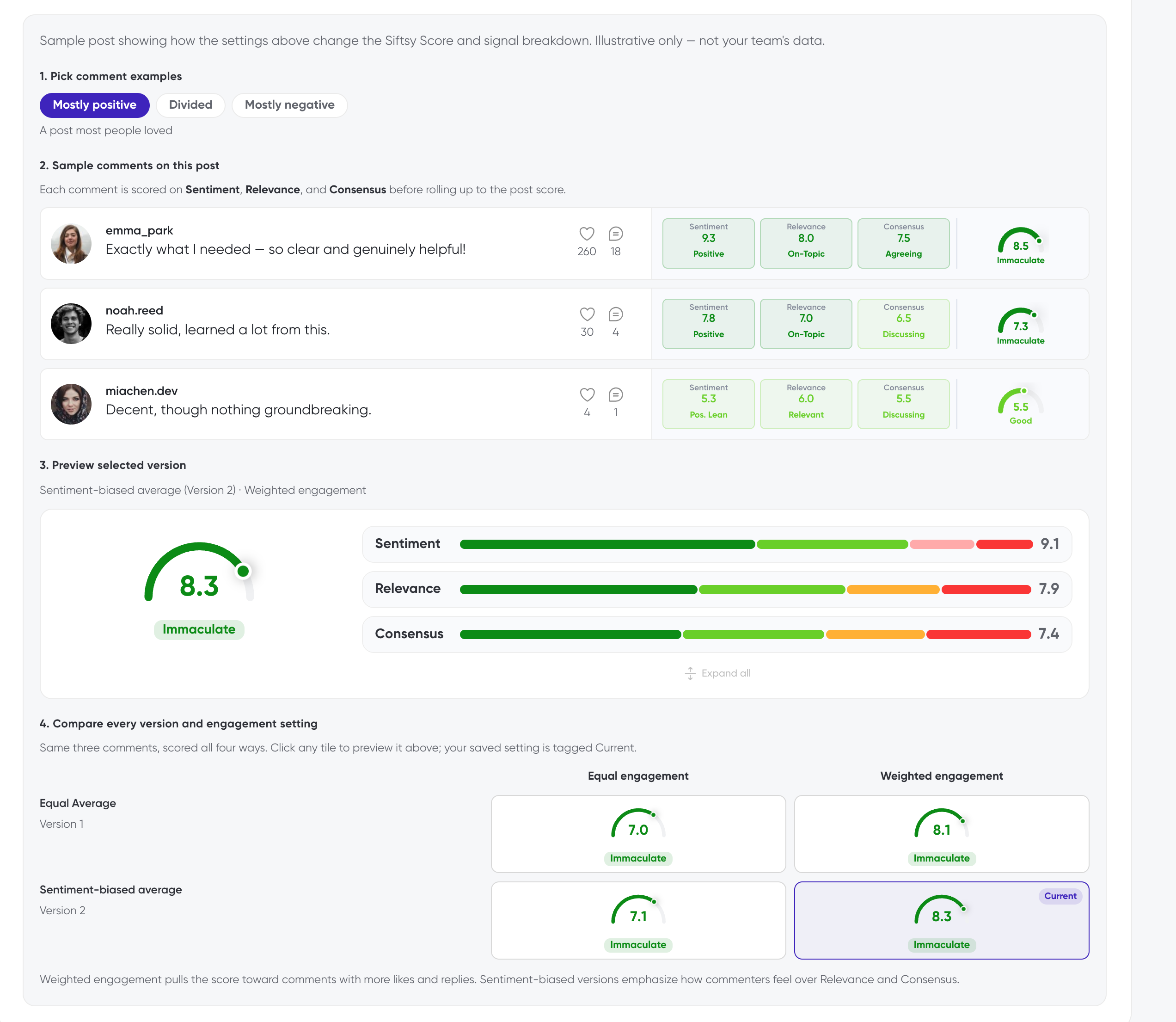
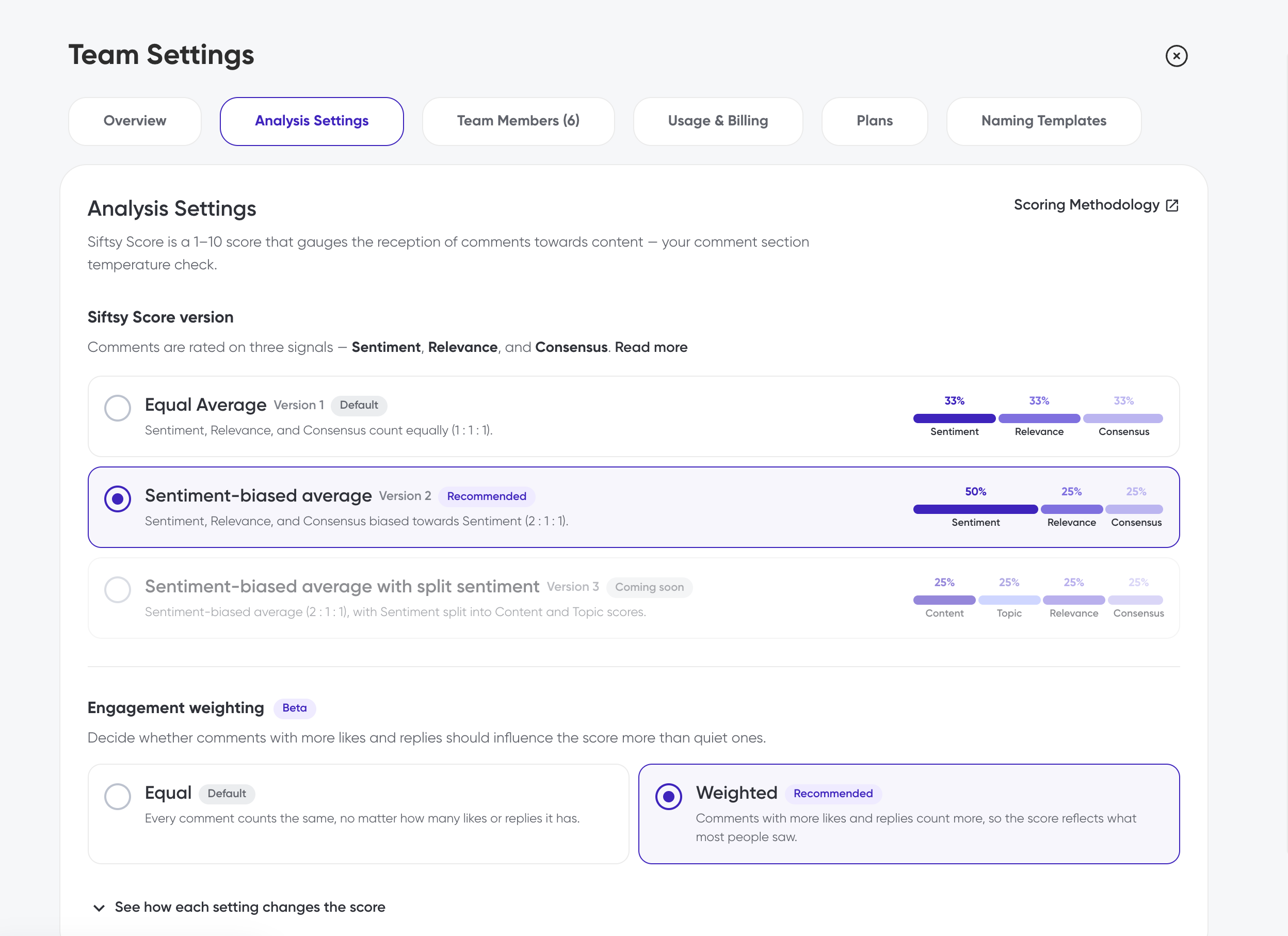
Equal Average (Version 1) — sentiment, relevance, and consensus are averaged equally. (1:1:1)
Sentiment-biased average (Version 2) — sentiment, relevance, and consensus are averaged with a bias towards Sentiment. (2:1:1)
Engagement weighting options:
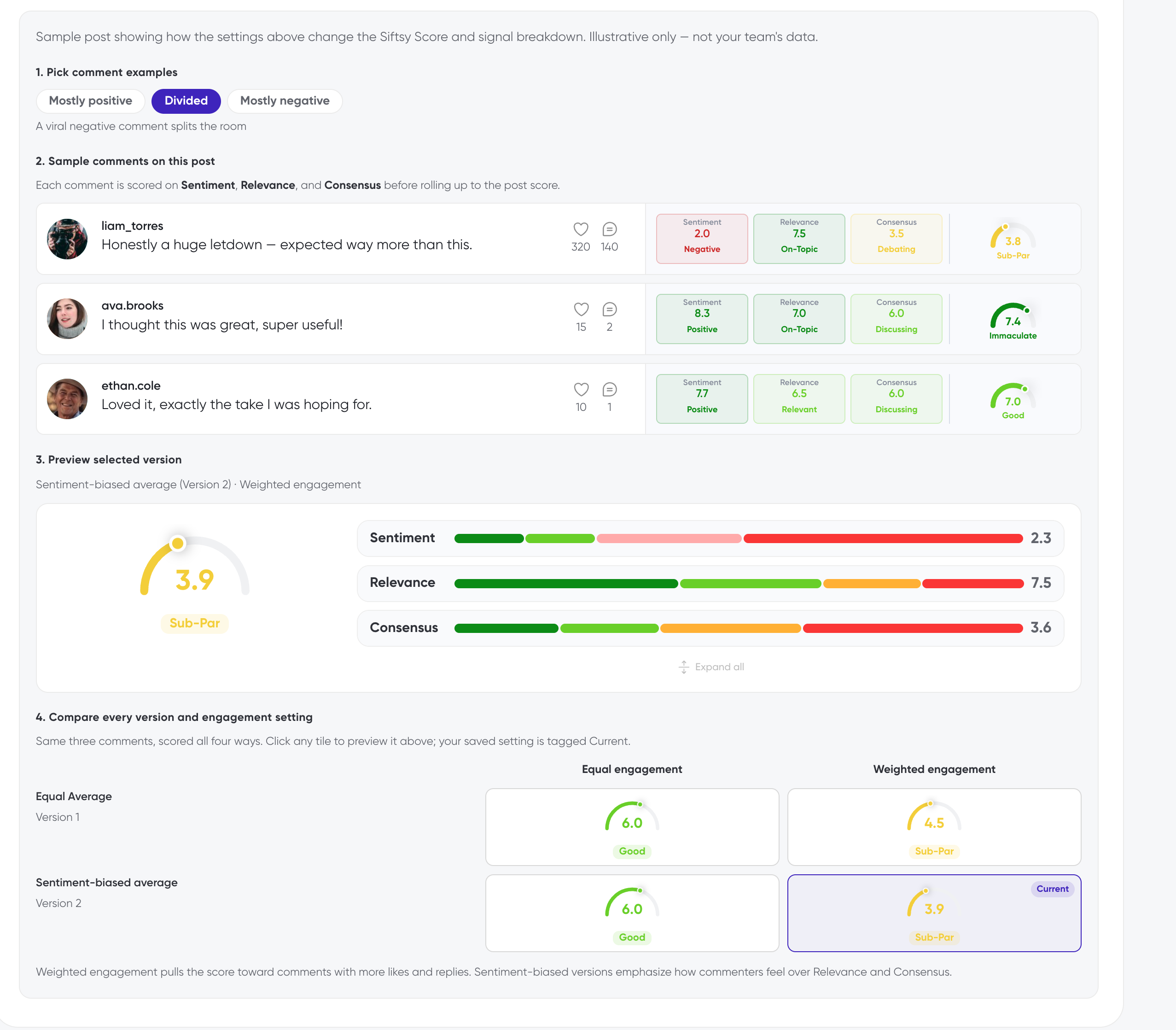
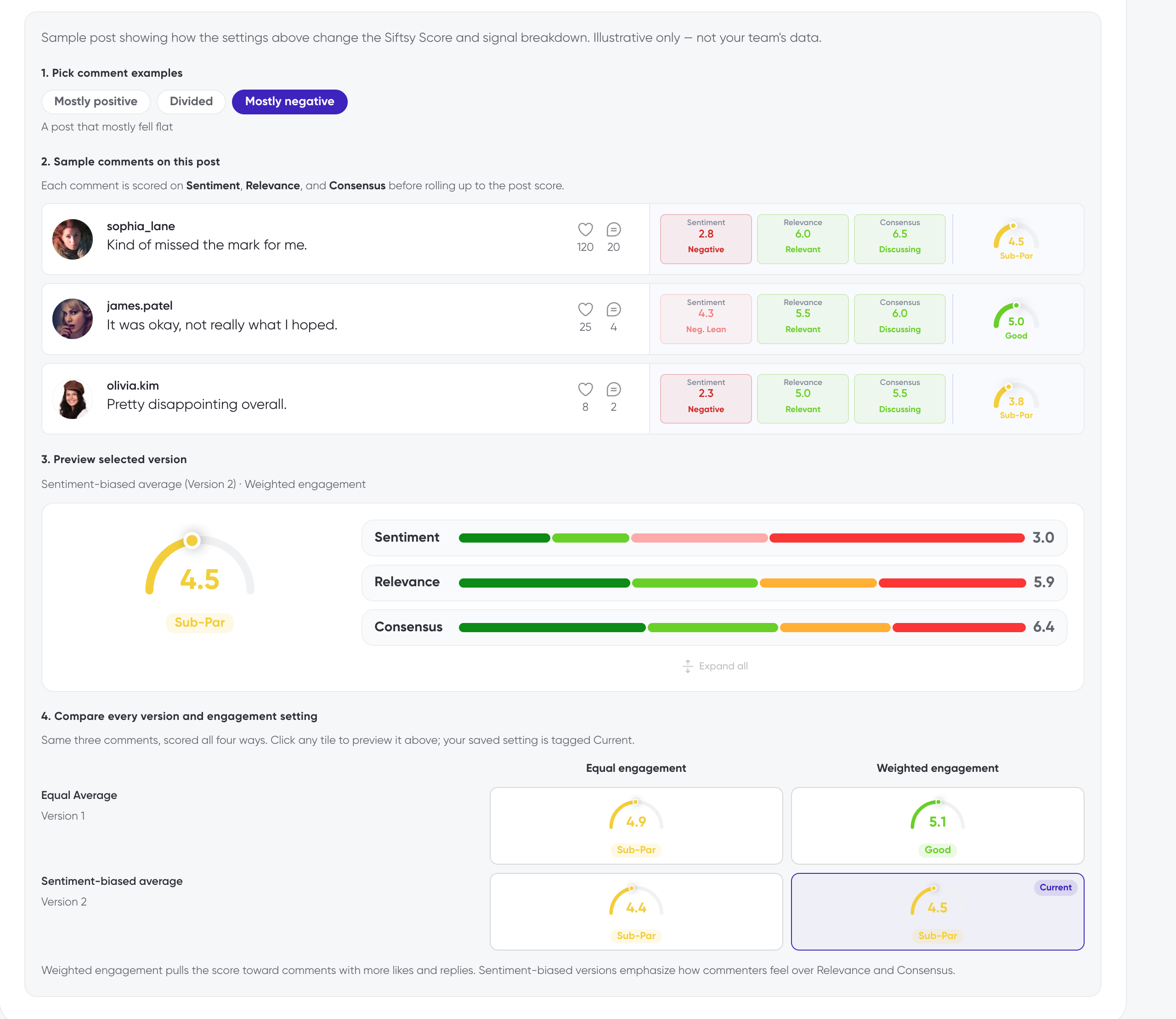
Equal engagement — every comment counts once, regardless of likes or replies. Scoring is balanced across all comments.
Weighted engagement — comments with more engagements (likes and replies) count more. Scoring is weighted more towards what most people saw, and what reactions are getting the most attention.
When the versions diverge
When a comment section mostly agrees, all four combinations land close together. The versions diverge when the room is divided — for example, one viral negative comment against several positive ones can read Good under equal engagement but Sub-Par under weighted engagement. Same comments, different question being answered.
How versions affect benchmarking
Yes — but consistently. When you change your Score Version, scores update across all of your team's data, past and present. Every post is scored the same way, so your comparisons and trend lines stay accurate. You can change your version at any time.
Which version to use
Balanced reporting → Equal Average + Equal engagement. An even read of the whole room.
Brand safety monitoring → Sentiment-biased average + Weighted engagement. Flags when strong negativity is getting amplified.
Audience perception → Equal Average + Weighted engagement. The section as a scrolling viewer experiences it.
Use the comparison grid in Analysis Settings to pressure-test your choice before committing.
Updating the Siftsy Score
To update the Score Version for your team, go to Team Settings → Analysis Settings. Your saved choice applies to all reports and is tagged Current in the comparison grid. You'll need admin access on the team to change this. You can change the versions and settings back anytime.
Coming soon: Version 3
Version 3 (Sentiment-biased average with split sentiment) is Coming soon.
Version 3 uses a more detailed breakout of the sentiment scoring that already exists under the hood. Instead of rolling up a single Sentiment signal, it draws on two dimensions of it:
Alignment — does the audience agree with the message of the post? (Opposed → Skeptical → Receptive → Supportive)
Topic — how does the audience feel about the thing being discussed? (Hostile → Critical → Favorable → Enthusiastic)
FAQ
Does switching re-analyze my comments?
Does switching break my benchmarks?
The updated Siftsy Score version applies to all of your team's data at once, so posts remain directly comparable. You can always switch the score back for normalized benchmarking.
Why did a score change when nothing else did?
Check whether your team's version setting changed in Analysis Settings.
Which version is "correct"?
None — they answer different questions about the same data.
Do labels like Good and Sub-Par change?
The thresholds are fixed; only the score feeding into them changes.
Related docs
Was this helpful?